
How to Build, Score, and Use a Risk Matrix for ISO
27001:2022 Compliance
A strong risk assessment is the foundation of ISO 27001. Whether your goal is certification, improving your security posture, or modernizing your governance practices, one tool matters more than anything else:
The ISO 27001 Risk Assessment Matrix
This matrix helps organizations evaluate threats, calculate risk scores, prioritize treatments, and make defensible security decisions. In 2025—an era of cyber attacks, cloud breaches, AI risks, and regulatory pressure—having a structured risk matrix is no longer optional. It’s mandatory.
This article explains:
- What a risk assessment matrix is
- Why ISO 27001 requires it
- How to construct a matrix
- How to measure likelihood and impact
- How to calculate risk scores
- How to map risks to Annex A controls
- A ready-to-use risk matrix template
- Best practices for 2025
- How automation tools like EnterpriseRM.ai simplify the entire process
Let’s dive in.
What Is an ISO 27001 Risk Assessment Matrix?
An ISO 27001 risk assessment matrix is a visual and analytical tool that helps organizations evaluate risks by mapping:
- Likelihood (how often it may occur)
- Impact (how severe the consequences are)
The matrix produces a risk score, which determines whether a risk is:
- Acceptable
- Needs treatment
- Requires urgent action
- Must be escalated to leadership
ISO 27001:2022 does not prescribe a specific matrix—but mandates a consistent, repeatable risk assessment methodology.
Your matrix = your methodology.
Why ISO 27001 Requires a Risk Assessment Matrix
ISO 27001 Clause 6.1.2 requires organizations to:
- Identify risks
- Analyze risks
- Evaluate risks
- Treat unacceptable risks
A matrix ensures these requirements are met systematically. It supports:
- Threat & vulnerability analysis
- Decision-making
- Resource allocation
- Control selection (Annex A)
- Evidence for auditors
- Risk acceptance justification
- Executive reporting
Without a proper risk matrix, your ISO 27001 compliance will lack structure, consistency, and audit readiness.
Sample ISO 27001 Risk Assessment Matrix (5×5)
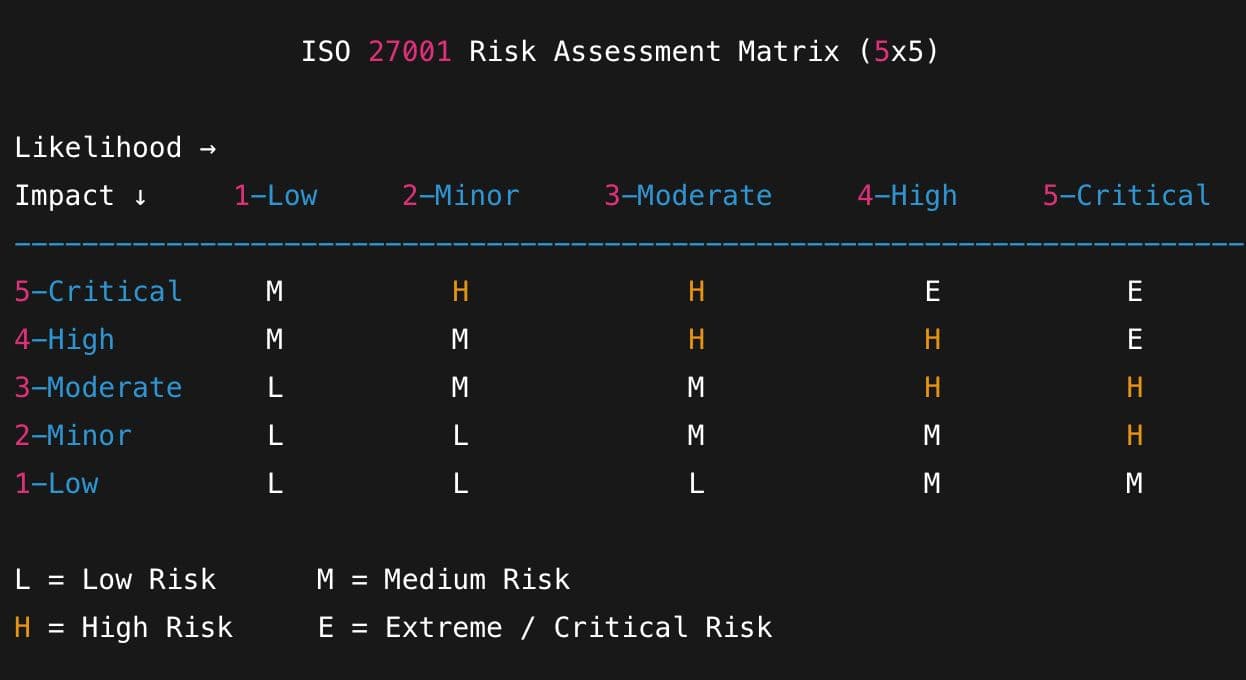
This matrix is acceptable for ISO 27001 and can be adapted to your severity levels.
Step-by-Step: How to Create an ISO 27001 Risk Assessment Matrix
Below is a complete, audit-ready method.
Step 1: Define Your Risk Criteria
ISO 27001 requires organizations to define:
- Likelihood scale
- Impact scale
- Risk acceptance criteria
- Scoring rules
Likelihood scale example (1–5):
| Score | Description | Example |
|---|---|---|
| 1 | Rare | Happened once in 5+ years |
| 2 | Unlikely | Could happen every few years |
| 3 | Possible | Occurs annually |
| 4 | Likely | Multiple times per year |
| 5 | Almost Certain | Frequent or ongoing |
Impact scale example (1–5):
| Score | Impact | Example |
|---|---|---|
| 1 | Negligible | Minor operational disruption |
| 2 | Low | Small financial loss |
| 3 | Moderate | Customer dissatisfaction, business interruption |
| 4 | High | Legal/regulatory consequences |
| 5 | Critical | Catastrophic financial/operational damage |
These criteria must be documented in your Risk Assessment Methodology.
Step 2: Identify Assets, Threats & Vulnerabilities
ISO 27001 promotes risk-based thinking.
You must identify:
- Assets → What needs protection
- Threats → What could happen
- Vulnerabilities → Weaknesses exploited
Examples:
| Asset | Threat | Vulnerability |
|---|---|---|
| Customer data | Ransomware | Lack of MFA |
| Source code | IP theft | Unprotected GitHub repo |
| HR records | Insider misuse | Excessive permissions |
| AI model | Data poisoning | Unvalidated training data |
Step 3: Assign Likelihood and Impact Scores
For each threat-vulnerability scenario, calculate:
Risk Score = Likelihood × Impact
| Scenario | Likelihood | Impact | Score |
|---|---|---|---|
| Ransomware attack | 4 | 5 | 20 |
| Unauthorized account access | 3 | 4 | 12 |
| Cloud misconfiguration | 5 | 3 | 15 |
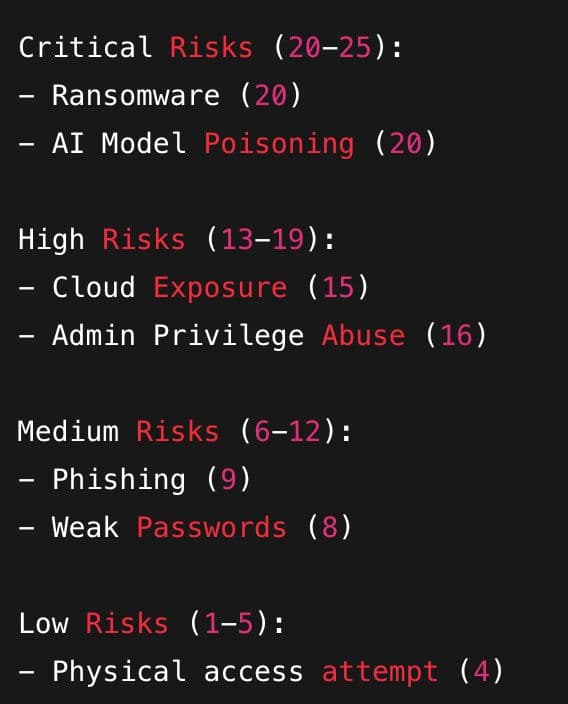
Step 4: Plot Risks on the Matrix
Once scored, insert risks into the matrix:
- 1–5 → Low
- 6–12 → Medium
- 13–19 → High
- 20–25 → Critical
Example visualization:
Step 5: Map Every Risk to ISO 27001 Annex A Controls
This is where the matrix becomes powerful. For every risk score above your acceptance threshold, map controls.
Example Mapping Table
| Risk | Score | Annex A Controls | Treatment |
|---|---|---|---|
| Ransomware | 20 | A.5.7, A.8.23, A.8.28 | Implement EDR, offline backups |
| Privilege misuse | 16 | A.5.15, A.5.18 | Add PAM and JIT access |
| AI model poisoning | 20 | A.8 (tech controls), ISO 42001 | Validate datasets, monitor anomalies |
| Cloud misconfiguration | 15 | A.8.1, A.8.20 | Implement CSPM |
This proves to auditors that risks are treated systematically.
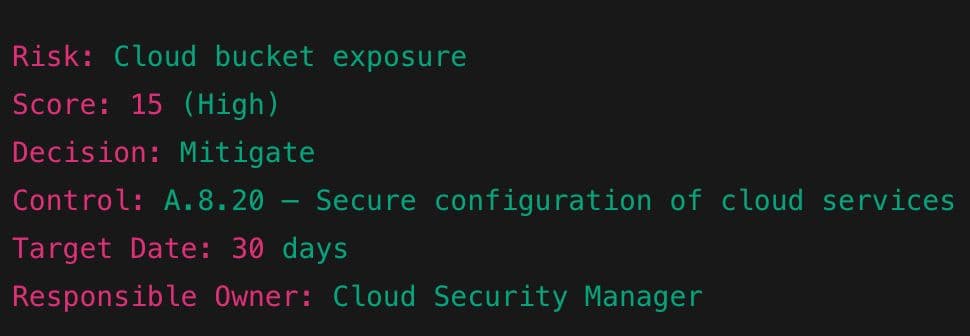
Step 6: Approve & Document Risk Treatments
Your Risk Treatment Plan (RTP) must include:
- Mitigation
- Transfer
- Avoidance
- Acceptance
ISO 27001 requires justification for every accepted risk.
Example entry:
Step 7: Monitor Risks Continuously (Not Annually)
ISO 27001:2022 shifts from annual assessment to continuous improvement.
You must:
- Reassess risks frequently
- Update treatment plans
- Maintain evidence
- Adjust controls as environment changes
- Review changes after every incident
Best Practices for Using a Risk Matrix
1. Include AI Risks
Add AI-specific threats:
- Hallucination
- Data poisoning
- Model theft
- Prompt injection
- Drift
2. Add Cloud-Specific Risks
Cloud misconfigurations are among the top breach causes.
3. Use Threat Intelligence for Scoring
Likelihood should reflect real attack frequency.
4. Avoid “one-time assessments”
Update continuously.
5. Automate Wherever Possible
This eliminates:
- Human bias
- Inconsistent scoring
- Missing evidence
- Spreadsheet chaos
Why EnterpriseRM.ai Simplifies ISO 27001 Risk Assessment
EnterpriseRM.ai provides:
- Automated risk scoring
- Prebuilt ISO 27001:2022 matrices
- Annex A control mapping
- AI-driven risk analysis
- Continuous assessment
- Real-time dashboards
- Audit-ready reports
- Integration with AI risk frameworks (ISO 42001, NIST AI RMF)
It eliminates spreadsheets and gives CISOs, CIOs, and compliance teams a unified platform.
Final Thoughts
An ISO 27001 risk matrix is more than a compliance requirement—it is a strategic tool that strengthens cybersecurity, supports decision-making, and aligns the entire organization toward resilience.
A well-designed matrix helps you:
- Identify risks early
- Calculate risk accurately
- Prioritize treatments efficiently
- Prove compliance to auditors
- Build a scalable ISMS
- Improve overall security posture
If your organization wants to elevate risk management maturity, a modern platform like EnterpriseRM.ai can help automate the entire process from end to end.
Continue Reading
Explore more insights on GRC and enterprise risk management