
How to Build a Compliance Management System (CMS)
Benita Sophia Michael
A Compliance Management System (CMS) helps organizations meet regulatory requirements, reduce risk, and stay audit-ready. This guide explains what a CMS is, why it matters, its core components, and how enterprises can implement a scalable, automated compliance framework.
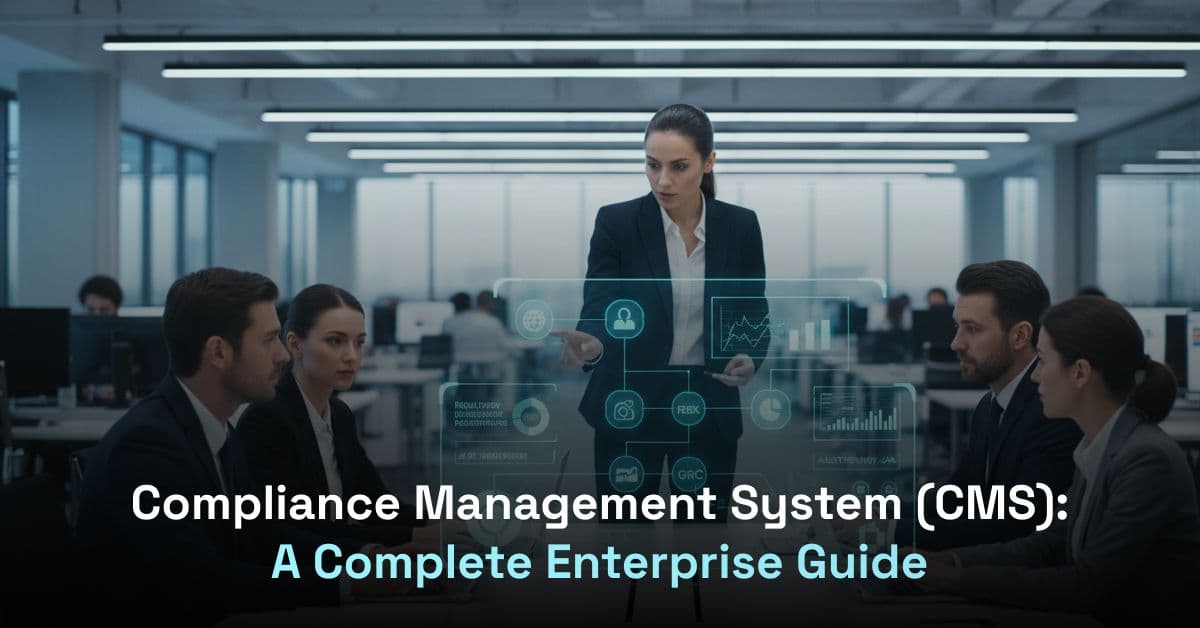
In today’s regulatory-first business environment, compliance is no longer optional—it’s foundational. From internal governance policies to global regulatory mandates, organizations must demonstrate continuous adherence or risk financial penalties, legal exposure, and reputational damage.
Even a single oversight can result in massive consequences. Large enterprises have faced multi-million-dollar fines due to unmanaged communication channels, weak internal controls, or lack of audit readiness.
This is why modern organizations need a Compliance Management System (CMS)—not as a checkbox exercise, but as a living, continuously monitored framework.
What is a Compliance Management System (CMS)?
A Compliance Management System (CMS) is a structured framework of policies, controls, workflows, and monitoring mechanisms that help organizations:
- Meet regulatory and statutory obligations
- Enforce internal governance policies
- Reduce compliance risk
- Maintain audit readiness
An effective CMS combines people, processes, and technology to ensure compliance is proactive—not reactive.
Core actions enabled by a CMS:
- Identifying applicable laws and regulations
- Defining policies and procedures
- Assigning accountability
- Monitoring controls continuously
- Conducting audits and assessments
- Training employees
Why is a Compliance Management System Important?
Non-compliance can lead to fines, legal scrutiny, loss of certifications, customer distrust, and stalled business growth. A CMS acts as preventive infrastructure, not damage control.
Key Benefits of a Compliance Management System
1. Proactive Risk Management
Regulatory requirements evolve constantly. A modern CMS helps organizations stay ahead by tracking regulatory changes and mapping them to internal controls in real time.
2. Process Automation
Manual compliance tracking is error-prone and slow. Automation enables:
- Scheduled control checks
- Automated evidence collection
- Reduced dependency on manual follow-ups
This increases efficiency and accuracy across compliance operations.
3. Competitive Advantage
Enterprises and regulated industries expect compliance maturity from vendors and partners. Demonstrating compliance readiness builds trust and shortens sales cycles.
4. Reduced Financial Exposure
The cost of non-compliance often exceeds the cost of compliance by several multiples. A CMS helps avoid penalties, investigation costs, and operational disruptions.
5. Centralized Visibility
A CMS provides a single source of truth for:
- Risk assessments
- Audit findings
- Training completion
- Control health
This eliminates silos and improves decision-making.
Key Components of a Compliance Management System
A strong CMS is built on interconnected components that reinforce governance, security, and accountability.
1. Policies and Procedures
Clearly documented, up-to-date policies aligned with regulatory requirements. These should be easily accessible and understandable across the organization.
2. Security & Compliance Workflows
Automated workflows for:
- Policy updates
- Control execution
- Incident response
- Training rollouts
Well-designed workflows ensure consistency and speed.
3. Entity-Level Controls
Compliance applies to people, systems, vendors, and assets. A CMS must enable granular control assessment and remediation at every level.
4. Continuous Monitoring & Surveillance
Compliance does not end with certification. Continuous monitoring ensures controls remain effective between audits and helps organizations prepare for surveillance audits.
5. Employee Training & Awareness
Employees are the first line of defense. A CMS must support training programs, policy attestations, and awareness tracking.
6. Internal Audit Management
Internal audits help identify gaps before external auditors do. A CMS enables structured self-assessments, issue tracking, and remediation workflows.
7. Certification & Audit Readiness
A CMS simplifies audit preparation by:
- Centralizing evidence
- Mapping controls to frameworks
- Supporting auditor collaboration
This significantly reduces audit timelines and effort.
How to Set Up a Compliance Management System
Implementing a CMS is an iterative process that evolves with your organization.
Step 1: Assess Requirements
Identify applicable regulations, internal policies, and current gaps. Involve legal, IT, security, and leadership teams early.
Step 2: Select the Right Platform
Evaluate CMS platforms based on:
- Scalability
- Framework coverage
- Automation capabilities
- Integration support
- User experience
Step 3: Plan Implementation
Form a cross-functional team to manage timelines, data migration, and ownership.
Step 4: Configure & Customize
Align the system with your compliance frameworks, internal processes, and risk appetite. Integrate with existing tools for seamless data flow.
Step 5: Train Users
Ensure employees understand how to use the system, why compliance matters, and how their role contributes.
Step 6: Migrate Data & Test
Move policies, risks, and evidence into the platform. Conduct testing to ensure accuracy and usability.
Step 7: Go Live & Optimize
Launch the CMS and continuously improve it based on feedback, regulatory updates, and organizational changes.
Compliance Management Software: What to Look For
An enterprise-grade CMS should offer:
- Support for multiple frameworks (ISO 27001, SOC 2, GDPR, HIPAA, PCI DSS, etc.)
- Risk and control mapping
- Continuous monitoring
- Automated evidence collection
- Audit collaboration
- Reporting and dashboards
How EnterpriseRM.ai Helps
EnterpriseRM.ai is an integrated Governance, Risk, and Compliance (GRC) platform designed for modern enterprises and fast-growing organizations.
What EnterpriseRM.ai Delivers:
- Centralized compliance and risk management
- Support for global regulatory frameworks
- Continuous control monitoring
- Automated audits and evidence management
- Vendor and third-party risk oversight
- Executive-level visibility through dashboards
EnterpriseRM.ai helps organizations move from reactive compliance to continuous, intelligence-driven governance—without operational friction.
Continue Reading
Explore more insights on GRC and enterprise risk management