
COSO ERM Framework: Linking Risk Appetite to Strategy
Benita Sophia Michael
A concise guide to COSO ERM’s evolution—from the 1992 ICIF and 2004 ERM to the 2013 update and 2017 strategy-centric model—and its five components. Learn how aligning risk appetite to strategy drives performance, with EnterpriseRM.ai operationalizing COSO via AI-driven monitoring and reporting.
COSO ERM Framework: The Strategic Link Between Risk Appetite and Business Strategy
COSO stands for the Committee of Sponsoring Organizations of the Treadway Commission. It was formed by five major professional organizations in the U.S.:
- American Accounting Association (AAA)
- American Institute of CPAs (AICPA)
- Financial Executives International (FEI)
- Institute of Management Accountants (IMA)
- Institute of Internal Auditors (IIA)
Why was COSO created?
In the early 1980s, the U.S. saw multiple corporate frauds, financial misstatements, and accounting irregularities. The National Commission on Fraudulent Financial Reporting, chaired by James C. Treadway Jr., was formed to address them.
COSO was established to:
- Improve financial reporting quality
- Reduce fraud
- Strengthen internal control practices
COSO Internal Control–Integrated Framework (1992) — A Landmark
In 1992, COSO released its most significant publication:
“Internal Control — Integrated Framework” (COSO ICIF)
This became the global gold standard for designing, implementing, and evaluating internal controls.
Key innovations in 1992:
- The 5 components of internal control
- Clear definitions of control environment, risk assessment, control activities, information/communication, and monitoring
- A common language for auditors, executives, and regulators
Why it mattered:
SOX (Sarbanes–Oxley Act) later used this as the default internal control framework for public companies.
COSO ERM Framework (2004) — Expanding to Enterprise Risk
In 2004, COSO introduced the Enterprise Risk Management (ERM) framework titled:
“Enterprise Risk Management — Integrated Framework”
This moved beyond internal controls and addressed:
- Strategic risks
- Operational risks
- Compliance risks
- Reporting risks
Key additions in 2004 ERM:
- Risk appetite
- Portfolio view of risk
- Objective-setting
- Event identification
COSO ERM was the first major step in aligning risk with business strategy.
Update of the Internal Control Framework (2013)
In 2013, COSO refreshed its original 1992 internal control framework to modernize it.
Why the update was needed:
- Technology disruptions
- Outsourcing & globalization
- Complex financial instruments
- Increasing regulatory expectations
Key enhancements:
- 17 principles linked to the 5 components
- Focus on fraud, technology, and governance
- Clarified roles & responsibilities
The 2013 version remains widely used today.
COSO ERM Framework Reimagined (2017)
The biggest modernization came in 2017 when COSO released:
“Enterprise Risk Management — Integrating with Strategy and Performance”
This version shifted ERM toward a value-creating, strategy-centric approach, emphasizing:
- Risk appetite embedded in strategic planning
- Performance-based risk evaluation
- Adaptive risk culture
- Integration of ERM with decision-making
The 5 updated components:
- Governance & Culture
- Strategy & Objective-Setting
- Performance
- Review & Revision
- Information, Communication & Reporting
This 2017 ERM framework is now the global standard for strategic risk management.
COSO Today — Modern Risk Governance
COSO continues to publish guidance on:
- ESG & sustainability reporting
- Cybersecurity risk management guidance (with Deloitte)
- Fraud risk management frameworks
- Compliance and internal control modernization
COSO’s work evolves with emerging risks, AI governance, and digital transformation.
In today’s complex business landscape, organizations can no longer afford to operate reactively. Market volatility, technological disruption, AI-driven risks, compliance pressures, and competitive forces require leaders to make faster, smarter, and more risk-aware decisions.
This is where the COSO Framework (Committee of Sponsoring Organizations of the Treadway Commission) becomes invaluable. Unlike traditional control-focused models, COSO takes a strategic, enterprise-wide approach to risk — ensuring that risk appetite is aligned with business objectives so executives can take calculated risks that fuel growth.
What Is the COSO ERM Framework today?
The COSO Enterprise Risk Management (ERM) framework is a comprehensive model that helps organizations:
- Identify risks across the enterprise
- Assess their impact and likelihood
- Define clear risk appetite and tolerance levels
- Link risk insights directly to strategic decisions
- Enhance governance, culture, and accountability
- Build resilience through monitoring and reporting
COSO is widely used across industries because it integrates seamlessly into strategy-setting, performance measurement, and governance processes — not just compliance functions.
The Power of COSO: Aligning Risk Appetite with Strategy
A standout feature of COSO is its emphasis on risk appetite — the amount and type of risk an organization is willing to accept in pursuit of its goals.
Why is this important?
Traditional risk management often leads organizations to avoid risk, which stifles innovation. COSO encourages leaders to:
- Take calculated, informed risks
- Avoid risks that exceed tolerance levels
- Allocate resources more effectively
- Balance growth with protection
- Support innovation while ensuring controls are in place
This alignment enables executives to shift from a defensive posture to a strategic, opportunity-focused mindset.
How COSO Links Risk Appetite to Business Strategy
Here’s how the COSO framework integrates risk appetite into strategic planning:
1. Strategy Setting
Before approving any strategy, executives evaluate:
- What risks come with this strategy?
- What opportunities does it unlock?
- Do these risks fit within our appetite?
This ensures strategies are not chosen blindly.
2. Performance Management
COSO embeds risk controls into performance indicators:
- KRIs (Key Risk Indicators)
- KPIs aligned with strategic risks
- Risk-adjusted performance measures
This provides executives with clarity when making trade-offs.
3. Governance and Culture
The board and executives set the tone:
- Clear communication of risk appetite
- Reinforcement through policy, incentives, culture
- Accountability across business units
This ensures risk appetite is consistently applied across the enterprise.
4. Decision-Making
When opportunities arise (market entry, AI adoption, product innovation), COSO helps evaluate:
- Risk-return choices
- Whether the risk still fits appetite
- Whether new controls are required
This empowers leaders to innovate confidently rather than fearfully.
The 5 Components of the COSO ERM Framework
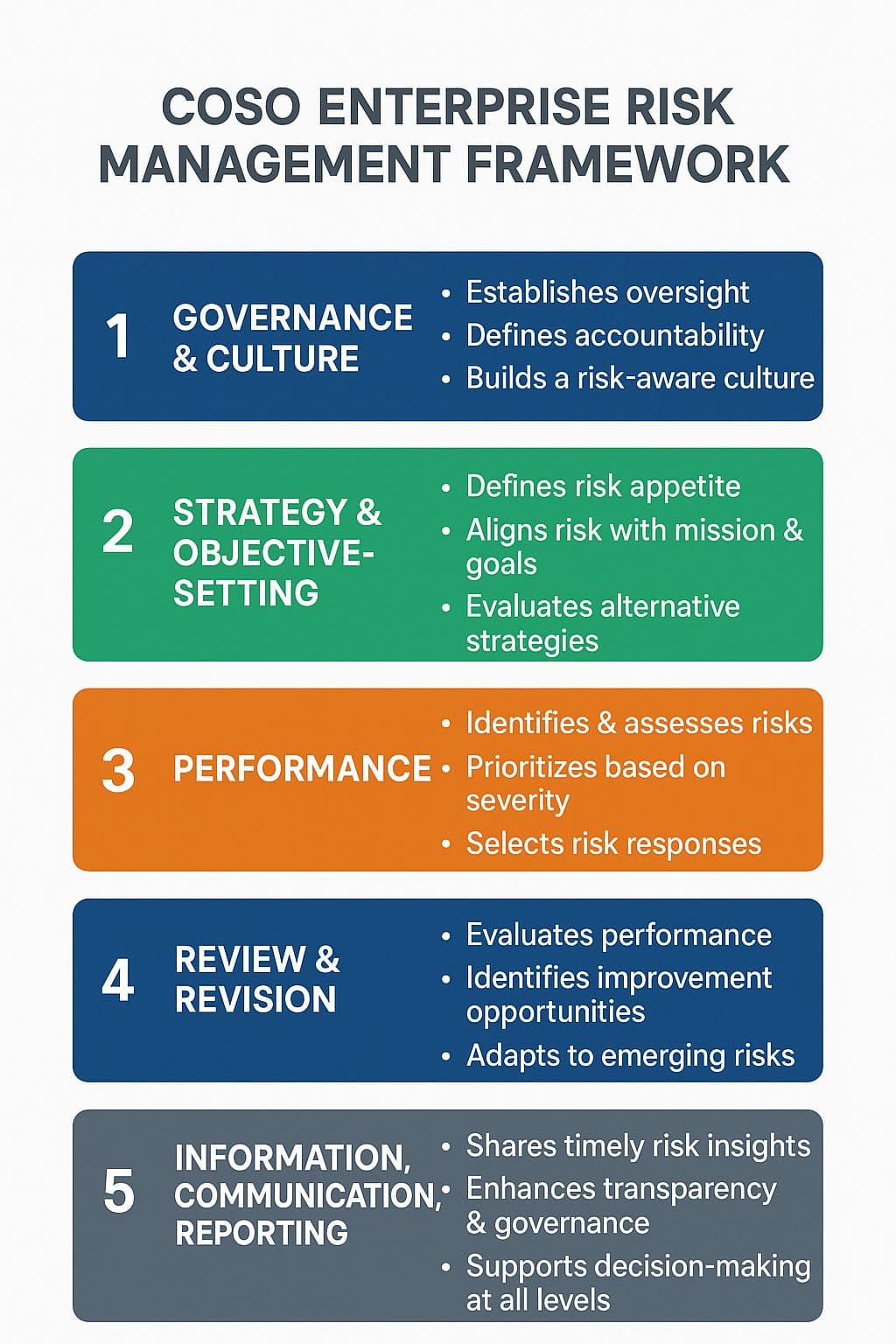
The updated COSO (2017) ERM model consists of five components:
1. Governance & Culture
Establishes oversight, risk appetite, and ethical tone from the board and leadership to support risk-aware decision-making.
2. Strategy & Objective Setting
Aligns risk considerations with business strategy development and objective establishment for value creation.
3. Performance
Identifies, assesses, prioritizes, and responds to risks linked to strategy execution, using tools like risk profiles and heat maps.
4. Review & Revision
Monitors risk and ERM effectiveness, pursuing improvements through ongoing evaluations and feedback.
5. Information, Communication & Reporting
Captures, processes, and shares risk insights across the organization and stakeholders to drive informed actions.
Why Executives Prefer COSO Over Traditional Risk Models
Unlike siloed frameworks, COSO:
| Traditional Risk Mgmt | COSO ERM |
|---|---|
| Reactive | Proactive |
| Compliance-driven | Strategy-driven |
| Avoid risks | Evaluate and accept good risks |
| Siloed | Enterprise-wide |
| Static | Dynamic & integrated |
COSO helps organizations shift from “risk avoidance” to risk intelligence — a major advantage for competitive, digital-first enterprises.
Who is using COSO today?
Numerous organizations across industries use the COSO ERM 2017 framework for enterprise risk management, often integrated with SOX compliance, strategy, and emerging risks like AI and cyber threats.
Notable Users and Adopters
- Public Companies (SOX Compliance): Widely adopted by U.S. public firms for aligning ERM with financial reporting and internal controls, as recommended by PCAOB and SEC guidance.
- Tech Startups and Enterprises: Used for strategic risk integration, e.g., app launches monitoring tech glitches, user feedback, and market risks.
- Financial Institutions and Banks: Applied for compliance risk management, with guidance from COSO/SCCE on regulatory risks.
- Global Professional Bodies: ACCA and IIA promote it for strategic business leader training and audits.
- Consulting and Software Providers: Tools like Sprinto, AuditBoard, and ERM platforms (e.g., NC State ERM Initiative) embed COSO ERM for clients in compliance-heavy sectors.
Real-World Example: COSO in Action
Real-World COSO ERM Use Case: Intuit (Financial Software Company)
Intuit, maker of QuickBooks and TurboTax, implemented COSO ERM to integrate risk with growth strategies, turning risks into opportunities.
Key Actions Using COSO Components
- Governance & Culture: Chief Risk Officer (CRO) and ERM program office own the program, with executive/business unit leaders accountable for risks.
- Strategy & Objective-Setting: Explicitly discusses risks/opportunities in growth planning (e.g., new product launches).
- Performance: Identifies, assesses, and responds to risks like cyber threats and market shifts via shared risk knowledge across units.
- Review & Revision: Regular progress reporting to leverage lessons learned.
- Information & Communication: Business units share risk insights for enterprise-wide decisions.
Outcomes
- Enhanced risk-aware innovation, avoiding costly failures in product rollouts.
- Improved cross-unit collaboration on emerging risks like data privacy
How EnterpriseRM.ai Complements the COSO Framework
Although COSO provides structure, many organizations struggle with:
- Documenting risk appetite
- Integrating risk into decision-making
- Maintaining a central risk register
- Continuous monitoring and reporting
- Cross-functional risk visibility
EnterpriseRM.ai solves these gaps by offering:
✔ A unified platform for risk identification, scoring & monitoring
✔ AI-powered risk predictions
✔ Real-time dashboards aligned with COSO principles
✔ Automated reporting for executives & boards
✔ Risk appetite configuration per business unit
✔ Integration with frameworks like ISO 27001, NIST, SOC2, and COSO
COSO tells you how to manage risk. EnterpriseRM.ai shows you what to do, when, and how fast.
Conclusion
The COSO Framework transforms risk management from a compliance activity into a strategic advantage. By aligning risk appetite with business strategy, it empowers executives to take smart, calculated risks that drive innovation, growth, and competitive advantage.
Organizations that adopt COSO — and strengthen it with modern tools like EnterpriseRM.ai — evolve from simply avoiding risks to leading with confidence in an uncertain world.
Continue Reading
Explore more insights on GRC and enterprise risk management